Looking only at those articles written in the last week, the most read stories cover the Royal Mint partnering with Recycling Lives Services, Intel’s CEO criticising the company’s engineering culture, and Imec making a quantum dot qubit using High NA EUV lithography.
And there’s also the sdsd and Huawei announcing it will have a 1.4nm equivalent density process in place by 2031.
As always, let’s take them in reverse order as according to Google Analytics:
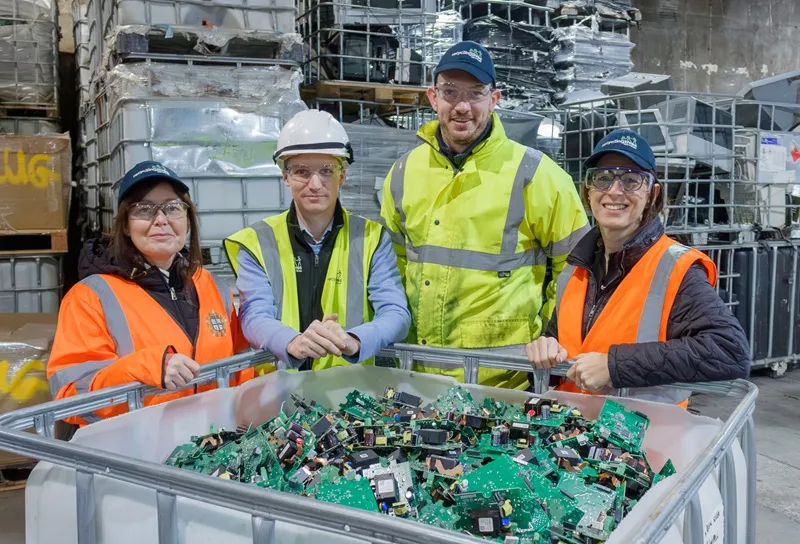 5. Royal Mint partners for UK e-waste recovery via prisoner workshops
The Royal Mint’s Reformation Metals department is partnering with Recycling Lives Services, which enables supervised prison-industry workshops, to support e-waste recovery. The initiative aims to create employment and skills development opportunities for prisoners in supervised work programmes. Circuit boards are first dismantled at Recycling Lives’ facility in Preston, Lancashire. And are then sent to Royal Mint’s centre in Llantrisant, South Wales. This will then extract the gold and other precious metals.
4. Re-Spins Get You Fired, Says Intel CEO [Mannerisms] Intel CEO Lip-Bu Tan has appeared to criticise the company’s engineering culture as being too lax. He has established a new rule for chip designs – one revision is acceptable, any more and it’s the sack. “I have a culture right now I have just implemented. It has to be A0 to production,” Tan told the JP Morgan Global Technology, Media and Communications Conference, “A0 is when you tape out, first time pass. Intel does not have that culture, so I tell that, first time pass A0. B0, you keep your job. Anything above that, you are fired.”
 3. Imec is first to make quantum dot qubit with high-NA
Imec is the first organisation to make a quantum dot qubit using High NA EUV lithography. A useful quantum computer, will require millions of connected qubits with high reliability and precise control. Of the various quantum platforms currently under investigation, silicon quantum dot spin qubits are considered a promising candidate for industrial scaling and are often referred to as ‘the industry qubits’.
2. Infineon expands CoolGaN BDS family
Infineon has expanded its CoolGaN BDS 40V G3 bidirectional switch (BDS) family with two new devices, the IGK048B041S and IGK120B041S. The new additions reduce PCB footprint by up to 82% and cut component count in half. For engineers designing within the strict spatial constraints of modern smartphones, notebooks and wearables, this is a significant and quantifiable step forward.
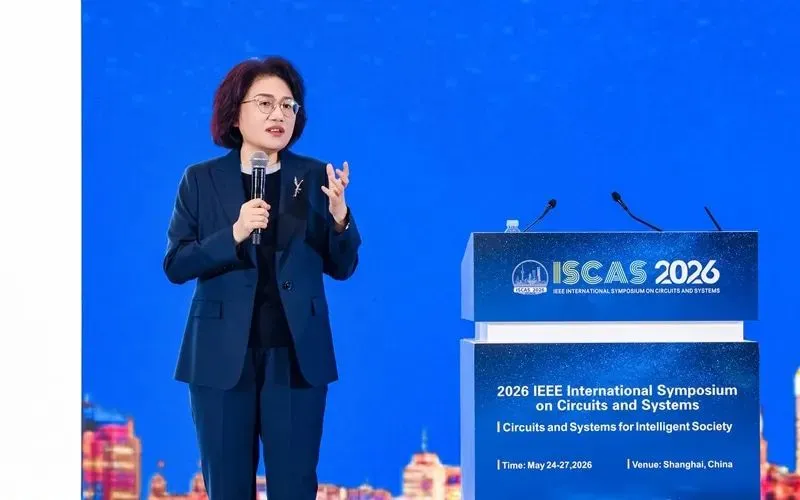 1. Huawei looks to 1.4nm by 2031
This morning Huawei announced it will have a 1.4nm equivalent density process in place by 2031 – only three years behind TSMC – without using EUV. At the 2026 IEEE International Symposium on Circuits and Systems in Shanghai, Huawei semiconductor president He Tingbo delivered a speech titled ‘New Semiconductor Path in Practice’ and said the company has developed a process called ‘Logic Folding’ by which it reduces the length of internal circuitry, thereby cutting latency and improving performance.